Stop explaining everything. Let your audience think.
A conversation with Andrew McLuhan on designing content that trains thinking instead of passive consumption.

Why saying more often makes ideas weaker
Most creators think clarity means helping the reader understand faster.
In practice, it often trains them to stop thinking altogether.
In a world flooded with content and shrinking attention, audiences default to passive consumption. Over-explaining reinforces this habit, discouraging the curiosity and experimentation that drive learning and engagement.
At first glance, you might see any friction as a failure of communication. But Andrew McLuhan doesn’t see it that way. He sees friction as the condition for understanding.
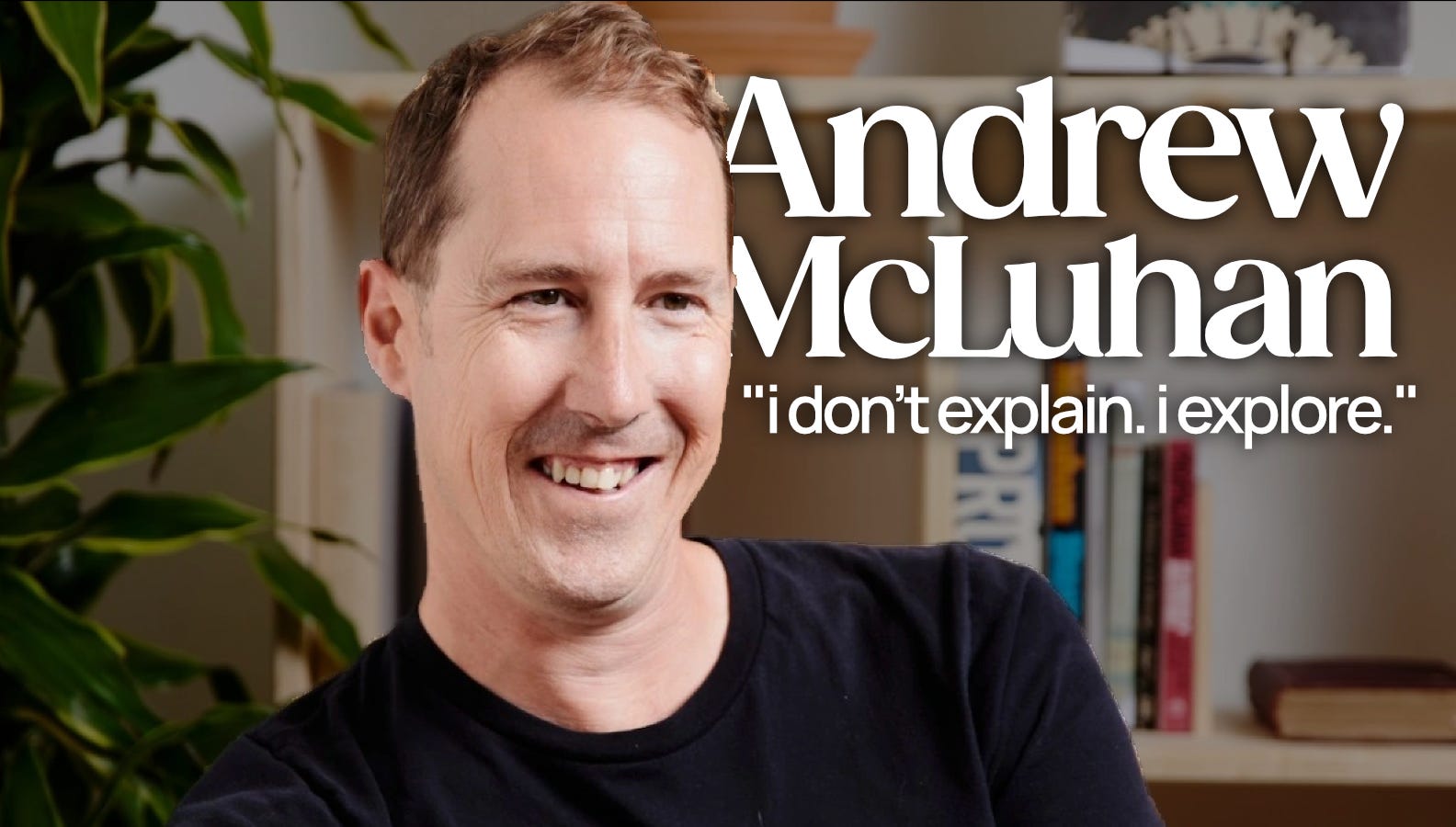
“I don’t explain, I explore”
In a recent conversation, McLuhan describes his approach simply: “I don’t explain, I explore.”
Explanation aims for closure. It resolves uncertainty, answers questions, and removes ambiguity. Exploration does the opposite. It keeps the question open long enough for the reader to notice what they normally pass over.
When a writer explains too much, they do the thinking on the reader’s behalf.
The reader may follow the logic, but they never experience the discovery.
McLuhan’s work, and his grandfather’s before him (Marshall McLuhan) resists this on purpose. His writing asks something of the reader. It withholds resolution just enough to force attention, pattern recognition, and participation.
If you want your audience to internalize ideas, you must leave room for discovery, not just comprehension. This influences choices about storytelling, tutorials, presentations, or product education.
Over-explaining is about control, not care
If you’ve ever added one paragraph just to be safe, this is about you.
If you’ve ever clarified a point not because it was unclear, but because you were afraid of being misunderstood, this is about you.
Over-explaining is rarely about the reader. It’s about the creator’s anxiety.
Anxiety about being misread. Anxiety about losing control of the interpretation.
Anxiety about silence.
So we fill the space. We anticipate every objection. We resolve every ambiguity. And in doing so, we quietly remove the very thing that makes understanding possible: the reader’s effort.
What Andrew McLuhan’s work makes uncomfortable is this idea that clarity is not something you deliver. It’s something you design for. And sometimes the most responsible thing a writer can do is to stop early.
What the “Laws of (New) Media” reveals that explanation can’t

The McLuhans developed a way to examine media that makes over-explanation look almost beside the point.
They called it the Tetrad, aka “The Laws of (New) Media.”
Every medium does four things at once…
It enhances something,
Makes something obsolete,
Retrieves something from the past,
And when pushed far enough, reverses into its opposite.
When you apply this lens, clarity stops being about what a message says and starts being about what a form does. The medium does the work whether the creator explains it or not.
This is why McLuhan insisted that content is often a distraction. “This is just a piece of meat,” as his grandfather put it, used to keep the mind busy while the medium reshapes perception underneath.
Over-explaining focuses obsessively on the meat. The tetrad forces you to look at the structure of the trap.
When simplification trains passivity
Look at how clarity is usually optimized in modern creator content.
Shorter explanations. Faster conclusions. Cleaner takeaways. The goal is to eliminate effort, to make ideas frictionless.
From the outside, this looks like progress.
But through a McLuhan lens, a different picture emerges.
Content engineered to explain everything enhances speed and certainty. Instead of prompting discovery, it relies on pre-packaged ideas like slogans and soundbites that are easy to grasp and share without effort. Push this too far, and it creates passivity: audiences who consume, repeat, and move on, but rarely change or engage deeply.
None of this requires bad intentions. In fact, it often comes from a desire to be helpful.
But when creators design primarily for explanation, they quietly train audiences to expect closure instead of curiosity. The medium teaches the habit long before the message is remembered.
Designing space for thinking
Designing space for thinking doesn’t mean being vague or withholding insight. It means to trust the reader enough to leave space, and to take responsibility for the cognitive habits your work quietly trains.
Example 1: Video content
Over-explaining: a tutorial that lists every step with no gaps.
Exploration: a tutorial that demonstrates the key moves but leaves small decisions to the viewer, prompting experimentation.
Example 2: Writing
Over-explaining: an article that interprets every quote and every data point for the reader.
Exploration: an article that poses provocative questions and lets the reader connect the dots themselves.
Example 3: Presentations
Over-explaining: a slide deck packed with notes that tells the audience everything.
Exploration: a slide deck that highlights patterns and trends, asking the audience to draw conclusions from the data.
Mini checklist: designing for thinking
Before you add one more paragraph, one more clarification, or one more takeaway:
Pause: Could this idea survive if I left part of it unresolved?
Trust: Am I leaving room for the reader to think, experiment, or question?
Effect: What cognitive habit does this train? Curiosity or passive consumption?
Medium: How does the form itself do the work? Could it teach without extra explanation?
A different test for clarity
Most creators ask: Did they understand me?
A better question is: What does this teach them to notice or question?
Explanation optimizes for speed and agreement. Exploration trains attention and participation. One disappears after consumption. The other changes how people read, watch, and think.
If your work disappeared tomorrow, would it leave behind a habit of thinking, or just a memory of having been understood?
As creators, designers, and communicators, we are in a competition for attention and cognitive impact. Over-explaining is not neutral: it teaches your audience to consume, follow, and forget, rather than think, question, or discover.
Choosing to explore rather than explain isn’t just style–it’s one of the most powerful decisions a creator can make, shaping how people think, behave, and engage long after your content disappears.
P.S. This essay is inspired by a conversation I had with Andrew McLuhan. His approach to explore rather than explain changed the way I design space for thinking.

content creators ❌
storytellers ❌
habit changers ✅